
- Kyiv, Str. Predslavinskaya, 38
- +38 050 332 2644
- [email protected]

Often at the start of Seo website promotion, many people come across such a concept as the semantic core of the site (hereinafter simply CL), in this article we will analyze in detail how to prepare the CL correctly and in quality, what nuances to pay attention to in order to avoid mistakes.
Semantic core (SN) is a database of keywords and phrases that help users find your site in search results. The collection of the semantic core is rightfully considered one of the most important stages of SEO optimization of the site, because the future fate and position of the site in the search results depends on the quality of its preparation. If, rightly, you collect SA, then after a series of works your site will receive an increase in targeted traffic, an increase in the number of targeted actions, as well as an increase in profits.
In this article, we will analyze in detail how to properly and accurately prepare a SA, what nuances to pay attention to in order to avoid mistakes.
When designing a site, many web masters ignore such a thing as a semantic core and design the site conditionally at their own discretion, which leads to gross errors and prevents users from finding the site in search results. Let’s take a look at why you need to build the semantic core:

Before moving on to the numerical values of each type of request, it is worth noting that it is necessary to correctly rank by frequency within each niche separately, because this indicator is affected by seasonality. Each niche has its own potential, for example, to promote the tire niche, high-frequency requests will start with a frequency of 5 000 requests per month, and for example, in the parquet laying niche, high-frequency requests will start from 500 people per month.
High-frequency keywords (HF) are the queries that users enter in the search most often. As practice shows, these are rather short queries, often they consist of 1 or 2 words.
Mid-frequency (MF) – these are requests that are considered not the narrowest, but not narrowly focused either, they occupy a niche between high-frequency and low-frequency requests. Typically, midrange queries contain specifics (for example, region, color, size, etc.). MF queries are much more difficult to promote than LF queries, only designing the structure and content is indispensable here, in order to promote such queries, it is necessary to increase the external link mass and at the same time use not only direct entries, but also various anchors that describe the page as fully as possible.< /p>
Low-frequency key queries (LF) – often these queries are also called long-tail queries, because they contain quite a lot of clarifications. Low-frequency requests are usually entered by users who know exactly what they are looking for, who are ready to perform a targeted action – to make a purchase or order a service. To advance in the LF, it is enough to work out the site structure, link between pages, and write content on each page with the necessary entries.

Before proceeding with the formation of the SA, it is necessary:
Next, the most time-consuming process begins – the collection of key queries, from which the semantic core of the site will be further formed, along which the promotion will take place.
There are two ways to collect SPs, we’ll go over them in more detail below.
For this approach, you need to select 2-3 competitors, collect using external tools, such as Serpstat or Ahrefs (we will analyze more resources for collecting a long list of requests in the article “Useful tools for SEO website promotion”), the entire database of keywords by which these sites are ranked. It is recommended to take keys for promotion starting with a frequency of 9. Keys with a frequency of less than 9 should not be paid much attention to. after the basic optimization for midrange, treble and bass, keys with a frequency of 1-9 will be pulled up to the top of the search results automatically.
Having collected the initial semantic core of competitors, it is necessary to further assess its quality. First of all, you need to get rid of junk and non-target keywords that got into the CL during the collection.
Junk requests include:
After the CL for the site is collected, it needs to be clustered, because it is not expedient and inefficient to work through documents of such volume manually in terms of time spent and budgets.
With this approach, it is necessary to determine which queries are most interesting for promotion and which queries are generally present in the niche. Next, you need to use any external tool, for example, Serpstat, to collect all the key phrases that contain the phrase / word that we are interested in for promotion.
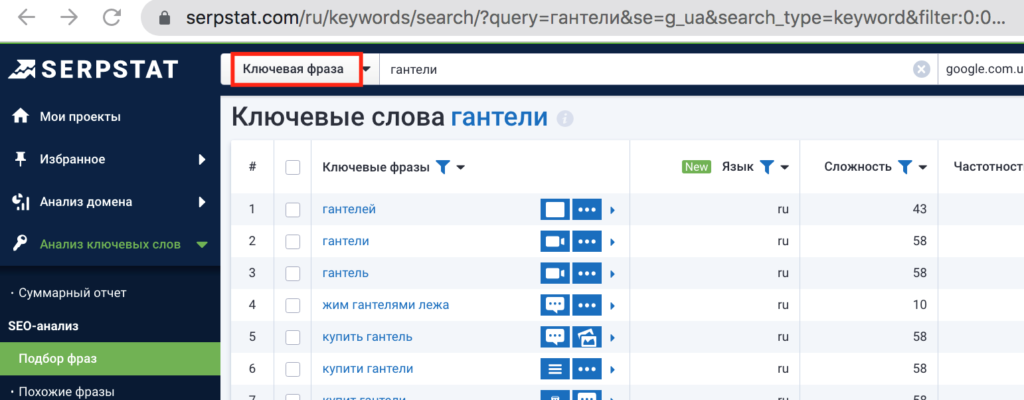
After long lists of requests have been collected, cleaned of junk requests, the clustering stage begins.
Clustering is a process in which requests that have a common theme that lead to the same page in the search results are grouped into cluster groups.
Each of the received keyword clusters will be used to promote and optimize one page.
There are several clustering methods: Hard, Soft and Middle. Below we will analyze each of them in detail.
Soft clustering – for this method, the most frequent key is used and all the others are selected based on it, i.e. all keys are interconnected by the most frequent key. This clustering method is suitable for news portals, information sites, small sites, because there are errors and errors in this method.
Middle clustering is the middle ground between Soft and Hard clustering. It all starts with the fact that the most frequent phrase is taken and the rest of the keys are compared with it by the number of common URLs, while there is a certain threshold for adding keys to the cluster (usually no more than 10), after which a new cluster segment is formed.
Hard clustering is a clustering in which the frequency key itself is compared with the following keys by the number of common URLs in the TOP-10 search results. This method is suitable for large sites, niches, where there is a lot of competition and where there are a large number of synonymous words. As a result, after this clustering, we get less SA than after SOFT and Middle, but more accurate.
There are many free resources on the Internet that allow you to quickly and efficiently cluster. Let’s take a look at some of them:

With this method of collecting keywords, a specialist manually works through each page of the site, collects semantics for a competitor and for target queries, and then “seats” the collected keys among the pages. This method is very time consuming. On the negative side, it can also be noted that with this option of working out the semantics, the specialist does not have the opportunity to work out and design the structure of the site with high quality, which deprives the site of the chance to have the most complete and extended structure that meets the demand. Collecting SL by hand for existing pages takes place if you need keys here and now for writing content or for prescribing meta tags. At the same time, it is important to understand that in the near future long lists of requests will be collected and the process of generating semantics for the site will be carried out by competitors with a complete design of the information structure.
Ending the article, I want to once again draw attention to the important points in the formation of the SA: